Our New Purchasing Scheme is Open! Until 31 July 2026, grab a 20% discount on 20 of our most popular collections! ✕
The East India Company: Laying the Foundations for British Colonial Domination of India, 1752–1774 - Volumes
Volumes
18 volumes in The East India Company: Laying the Foundations for British Colonial Domination of India, 1752–1774 | Page 3 of 5
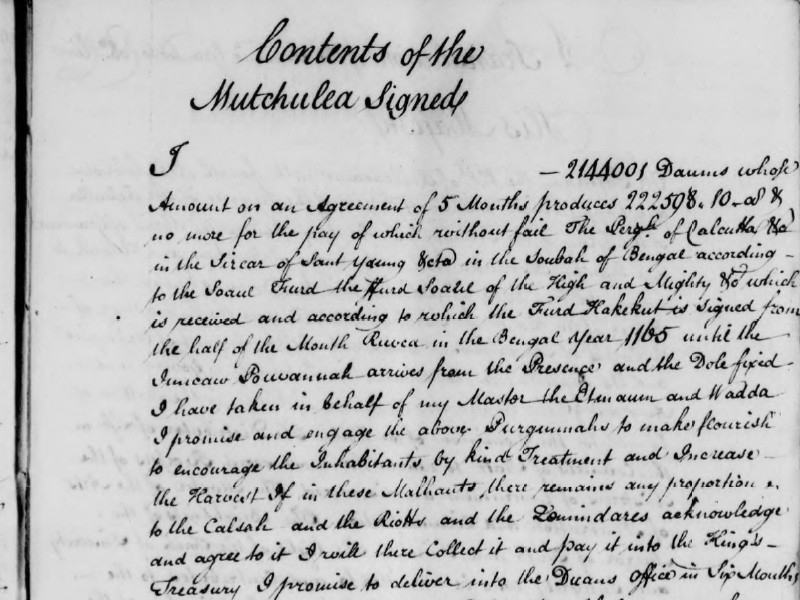
Jagir papers, 1758-1767
Sub-series CE: The jagir was the annuity of 300,000 rupees or £27,000 granted to Clive in 1759 by Mir Jafar, the Nawab of Bengal, as a reward for his services in defending Bengal against the attacks of the Shahzadah [son of the Emperor]. Based on the land revenues that Mir Jafar received from the Company for the district around Calcutta, the jagir substantially increased Clive's personal fortune but became a bone of contention between himself and the Court of Directors. Scope and content: Original grant of the jagir together with deeds and correspondence, 1758-1767, relating to its subsequent administration. Arrangement: In three documents: original grant and related papers, deeds and correspondence. Extent: 2 bundles, 1 vol. Read more →
![View volume: Acquired India papers, 1727-[c.1763].](https://d1sxy7l4fhu207.cloudfront.net/uploads/staging/1814/conversions/BOA_TEIC_Volume10_1632393298-800x600.jpg)
Acquired India papers, 1727-[c.1763]
Sub-series CG: The papers of Company servants who served before and during Clive's time in India comprising the journals of Henry Harnett, 1727-1729, ledgers of Henry Harnett, 1727, voyage journals of Henry Doidge and others, 1757-1759, and papers of William Dobbins, [c.1760-c.1763]. Custodial history: Apart from the occasional internal reference, the presence of the papers is not generally explained other than that Clive presumably acquired or inherited them either in a personal or official capacity during his own service in India. Arrangement: In four documents: journals of Henry Harnett, ledgers of Henry Harnett, voyage journals of Henry Doidge and others, and papers of William Dobbins. Extent: 7 vols., 1 envelope. Read more →

Supplementary papers concerning the trial of Nandakumara
Correspondence and other materials, chiefly dated 1787-1788, from the Indian papers of the 1st Earl of Minto, concerning his management of the impeachment of Sir Elijah Impey, formerly Chief Justice of Bengal, for his conduct of the trial of the Maharaja Nandakumara in 1775 for forgery. Read more →
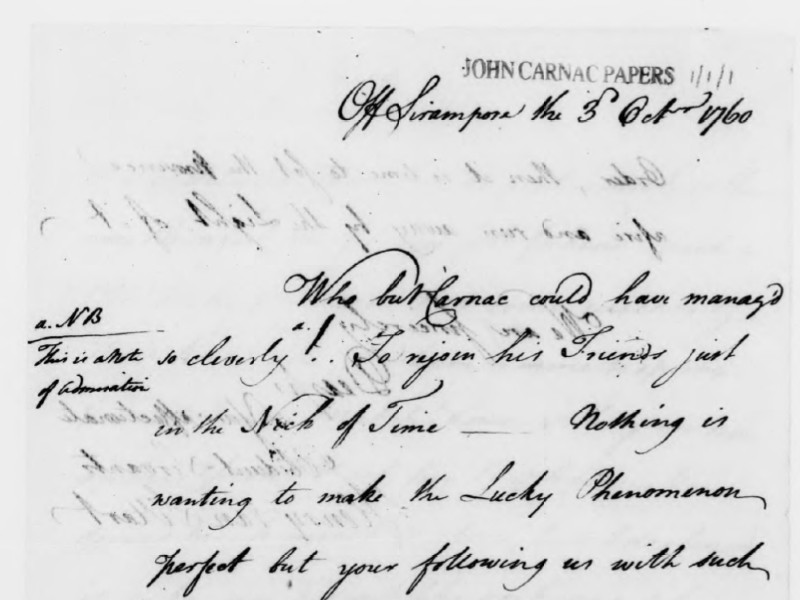
The correspondence of Brigadier-General John Carnac, 1760-1769
John Carnac joined the army of the East India Company with the rank of captain in 1758, after seeing service with the 39th infantry regiment. Between 1760 and 1761, as Commander-in-Chief, he fought and ultimately defeated the French-supported forces of the Mughal Emperor, Shah Alam II, near Bihar. Made Brigadier-General in 1764, Carnac again assumed the command of the EIC's army, defeating the Marathas in 1765 before handing control back later that year to Robert Clive. From 1776-1779 he was a Member of Council, Bombay, and a member of the Superintending Committee on the expedition against Poona in 1778. He was dismissed from the EIC for his share in the Treaty of Wadgaon in 1779, under the terms of which the Company relinquished control over all lands gained during the previous four years. Despite this Carnac remained in India until his death at Mangalore in November 1800. The present collection, now held at the National Library of Wales, Aberystwyth, comprises some 2,000 items of correspondence focusing on the earlier period of Carnac's life in India, from 1760 to 1767. This was a period of major political change, with a succession of four different nawabs in Bengal and a change of Mughal Emperor in Delhi. Including a small number of letters in Persian, its emphasis on the years between 1763 and 1766 helps to fill the gap in coverage of events occurring during Clive's absence from India between March 1760 and April 1765. At the same time, the letters serve to amplify our understanding of Clive's third and final tour of duty, by providing the opportunity to contrast how two senior British figures set about implementing the East India Company's new approach, combining commercial interests in Bengal with its growing political power. Read more →
Unlock Historical Research for Your Institution
Provide your students and researchers with direct access to unique primary sources.
