The correspondence of Arthur C. Murray, 3rd Viscount Elibank
It sheds light on Anglo-American relations from the First World War to the Second; and it reveals Murray's personal and political relationship with Franklin D. Roosevelt through his Presidency until his death in 1945
Tony McCulloc, University College London
Access the full collection
Access the full archive of British Diplomacy with America and Ireland: an Ambassador's Letters, 1909–1962.
Explore the development of Britain's relationship with Franklin Roosevelt
Arthur Cecil Murray was elected as a Liberal Party MP for Kincardinshire in 1903, a seat that he held until 1923. During the First World War, he served as Private Secretary to Sir Edward Grey, who held the position of Secretary of State for Foreign Affairs. From 1917 until 1918, Murray served as the Assistant Military Attaché to the British Embassy in Washington. There, he worked with Franklin Roosevelt and the two became close friends. They wrote to each other until Roosevelt's death in 1945. The Murray-Roosevelt correspondence contained in this collection reveals how Roosevelt’s foreign policy evolved prior to the outbreak of the Second World War. For example, it discusses Roosevelt’s influential “Quarantine Speech” of October 1937 and the pivotal Munich settlement with Adolf Hitler in 1938.
Murray’s correspondence also helps to illuminate a key phase in the history of modern Ireland—he was a prominent member of the Irish Home Rule Council. He was likewise in frequent contact with Colonel House, Woodrow Wilson's key adviser during the Great War. Murray's other key contacts included Walter Runciman, President of the Board of Trade during the Great Depression, and William Lyon Mackenzie King, Canadian Prime Minister during the Second World War.
Murray’s wide-ranging correspondence with leading figures constitutes an excellent resource for students, researchers, and educators interested in British and Irish politics, as well as British-American relations, throughout the early to mid-twentieth century. It will also appeal to those exploring the broader themes of international relations and modern diplomacy.
Contents
British Diplomacy with America and Ireland: an Ambassador's Letters, 1909–1962...
The correspondence of Arthur C. Murray, 3rd Viscount Elibank
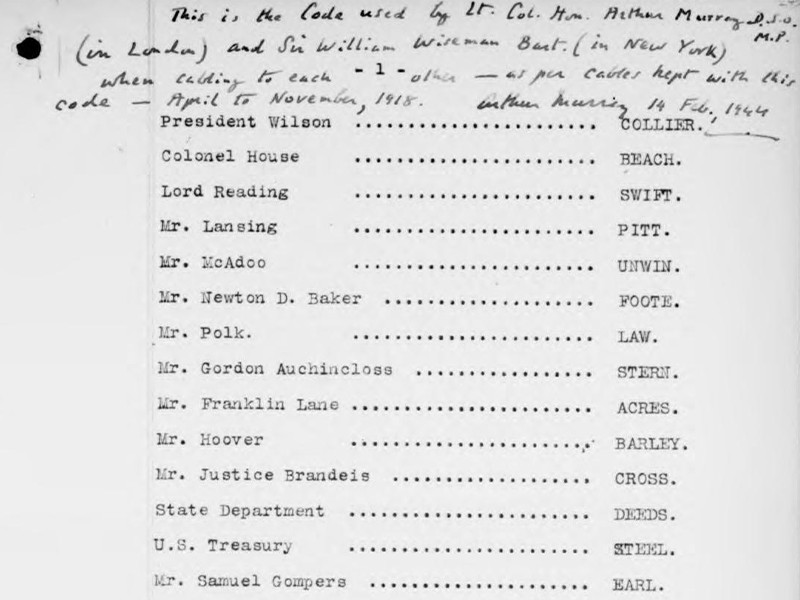
This document (images 299–304) details the cyphers that Murray used in 1918 when cabling Sir William Wiseman, head of the British Secret Intelligence Service in the US. Based in New York, Wiseman was in close contact with President Woodrow Wilson and Wilson’s personal adviser, Colonel Edward House. In these cyphers, “Collier” referred to Wilson, “Beach” to House, “Cotton” to the British Prime Minister, and “Christian Science” to the League of Nations.
Licensed to access
Murray and MacDonald
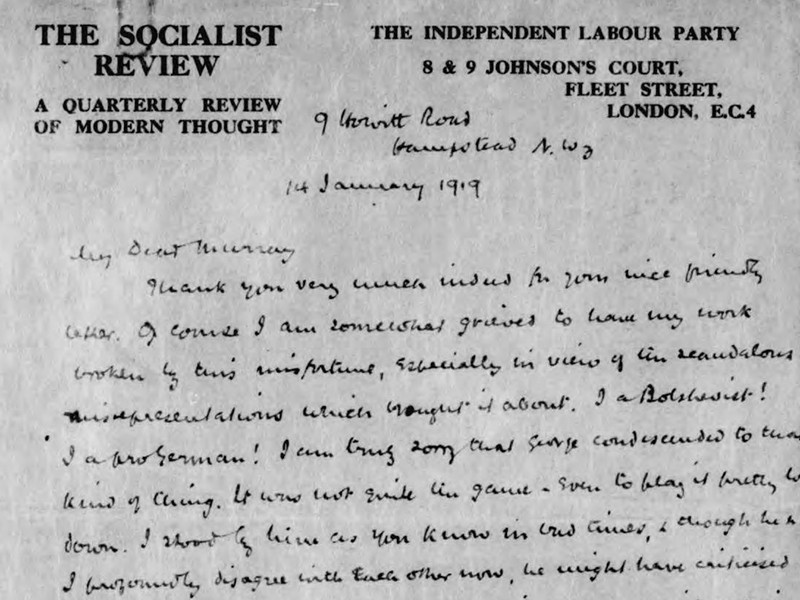
Fellow Scotsmen, Murray and Ramsay MacDonald were friends and frequently corresponded. In this letter (images 3–4), written after the 1918 General Election, MacDonald complains about how Lloyd George branded him a “Bolshevist” and “pro-German” during the election campaign. As a prominent member of the Independent Labour Party at the time, MacDonald expressed doubts about his political relevance and future. “I belong neither to the Right nor the Left!”, he wrote. “I am neither Tory nor Jacobin, neither Constitutionalist nor revolutionist, so perhaps there is no place for me!"
Licensed to access
“Your everlasting Irish situation”
Murray’s knowledge of Irish politics proved useful in Washington—he observed how his government’s policy in Ireland had consequences in the US, with its sizeable Irish-American population. In this letter (image 112), Franklin Roosevelt asks Murray to visit him. At the time, Roosevelt was James Cox’s running mate for the presidential election. “It would amuse you to hear the questions put to me with regard to your everlasting Irish situation”, Roosevelt wrote. “I wish to goodness you could find some way of taking it out of our campaign over here!"
Licensed to access
“The Murrays of Falahill”
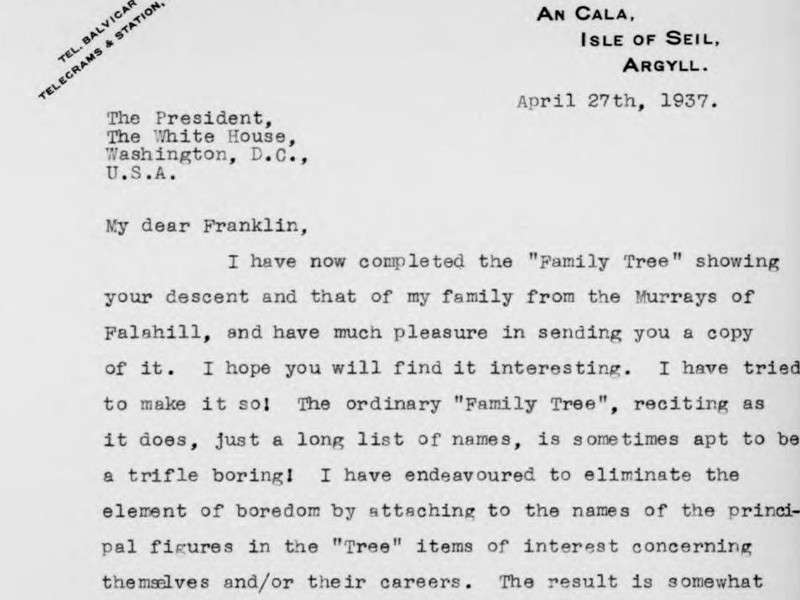
Murray believed that Roosevelt and he were descended from the Murrays of Falahill, a Scottish family. In this letter (images 25–27), Murray informed the president that he had completed the “Family Tree” and that he would be hosting a luncheon for distinguished guests, such as Mackenzie King and Walter Runciman. Murray also reflected on the situation with Hitler. In his response (image 28), Roosevelt wrote that he reckoned that his own “radicalism descends direct . . . from John Murray “the outlaw,” of Falahill”.
Insights
As an ambassador to the United States during the First World War, Murray liaised with the American administration. He received information upon its leading figures from his colleagues in the intelligence service.
Murray was involved in Irish politics in the build-up to the First World War—he served as treasurer of the Home Rule Council until the outbreak of the conflict.
Franklin Roosevelt developed a friendship with Murray when they worked together in Washington. Correspondence dating from 1919–1936 sheds light on key political trends and issues, such as Roosevelt's bid for the presidency in 1932.
Eleanor Roosevelt continued to correspond with Murray until his death in December 1962. Correspondence from the period 1949–1953 contains the most detailed letters. They discussed the formation of NATO, for example, as well as other key developments in international relations.
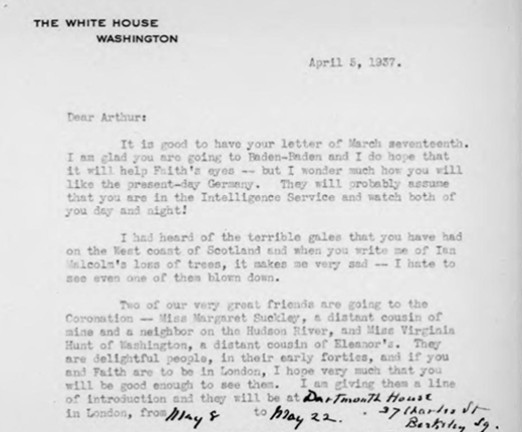
Our latest “Document of the Week” was chosen by our Academic Liaison Manager, Dr Catherine Bateson. It is a letter from President Franklin D. Roosevelt to Arthur C. Murray, written on 5 April 1937.
Read more →