“We are a group of American women in a foreign land, and we have the responsibility and duty of demonstrating the strongest and finest qualities of our own country” (February 1936)
Clubs flourished between 1880 and the mid-1920s, leading [ . . .] women from varying class, racial, and ethnic/religious backgrounds to join organizations for self-improvement and social benevolence.
Anne Ruggles Gere and Sarah R. Robbins, "Gendered Literacy in Black and White" (1996)
Access the full collection
Access the full archive of American Women's Club Magazine, 1925–1936.
Explore the social, educational, and philanthropic activities pursued by a women’s club throughout the interwar period
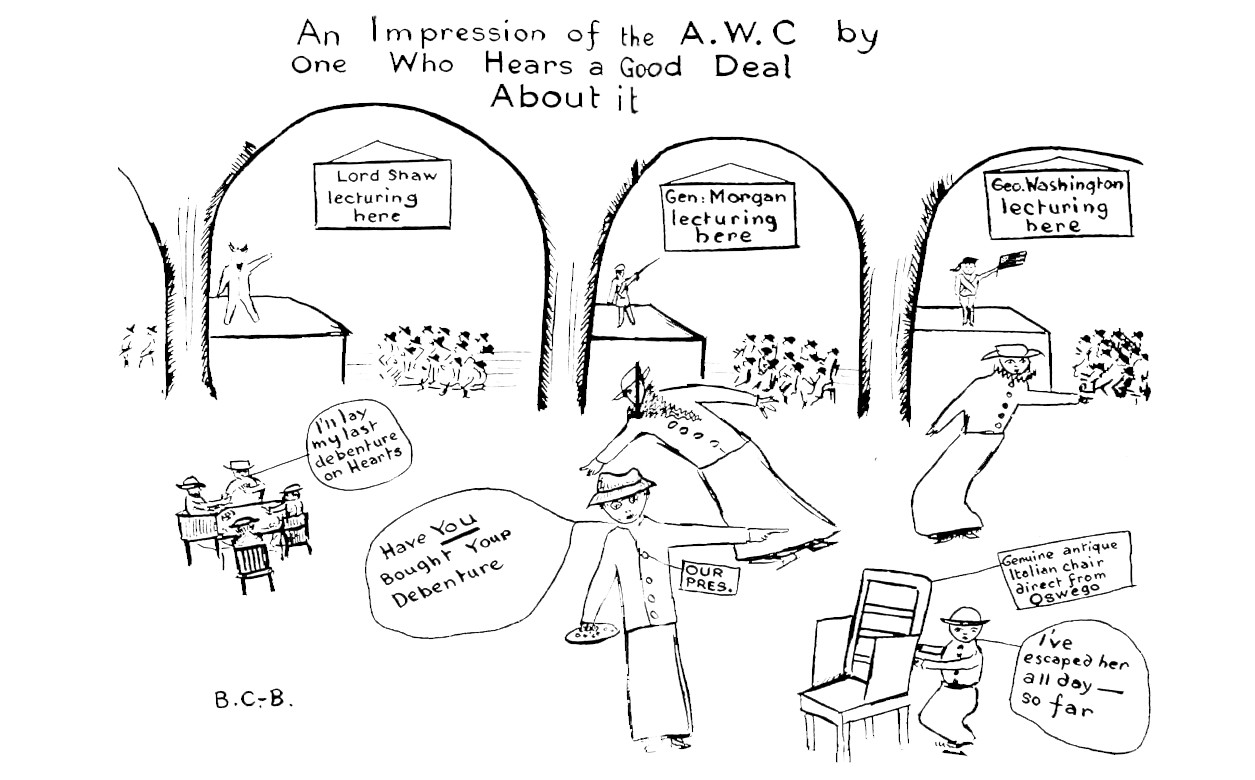
Founded in May 1899 as the Society of American Women in London, the American Women’s Club (AWC)—as it became known in 1916—was an organisation for female expats from America. In the first edition of the American Women’s Club Magazine (AWCM), the club’s first president, Mrs. Hugh Reid Griffin, described how the AWC stemmed from a shared belief that “serious social intercourse would lead to useful service and would create a centre of our own in the land of our sojourn”. By the 1920s the AWC had 1,500 members and boasted a lavish, fully-staffed headquarters at 46 Grosvenor Street in Mayfair.
Consisting of nearly 3,400 images, this collection brings together editions of the ACWM that were published monthly between January 1925, when the magazine was launched, and December 1936. Articles in the AWCM detail the club’s history and evidence its outgoing, civic ethos. The collection provides detailed insights into the varied social, educational, and philanthropic activities that AWC members pursued. It likewise illuminates the extensive local, national, and international (especially transatlantic) networks within which the club and its members operated. An intriguing collection, it sheds light upon the influential women’s clubs movement throughout the early twentieth century, as well as upon the wider social, political, and cultural contexts that precipitated and shaped institutions like the AWC.
Contents
American Women's Club Magazine, 1925–1936...
“We are a group of American women in a foreign land, and we have the responsibility and duty of demonstrating the strongest and finest qualities of our own country” (February 1936)
Licensed to access
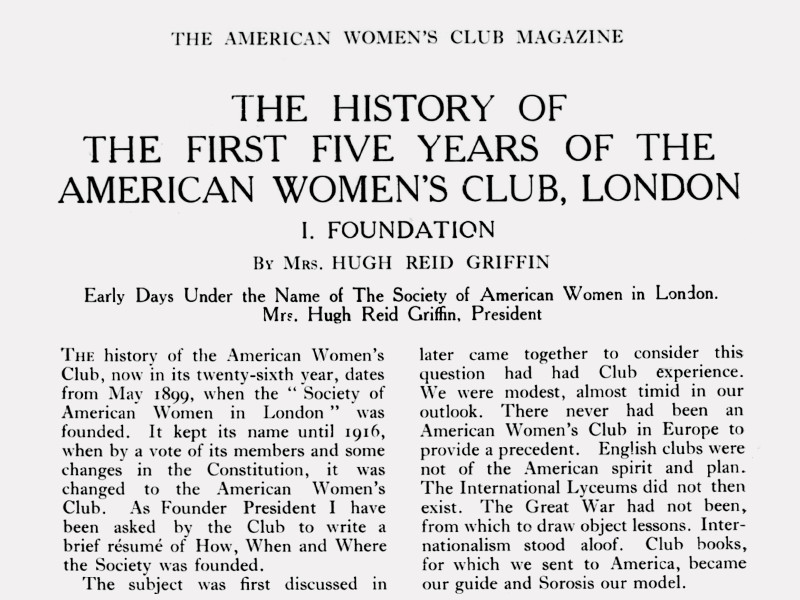
Foundation of The American Women’s Club
The AWCM was launched in 1925. Its early editions featured a six-part series documenting the history of the club. It describes how the idea of the club was conceived of in November 1898 and how this vision was translated into reality in May of the following year. The series also sketches the club’s early activities and ethos.
Licensed to access
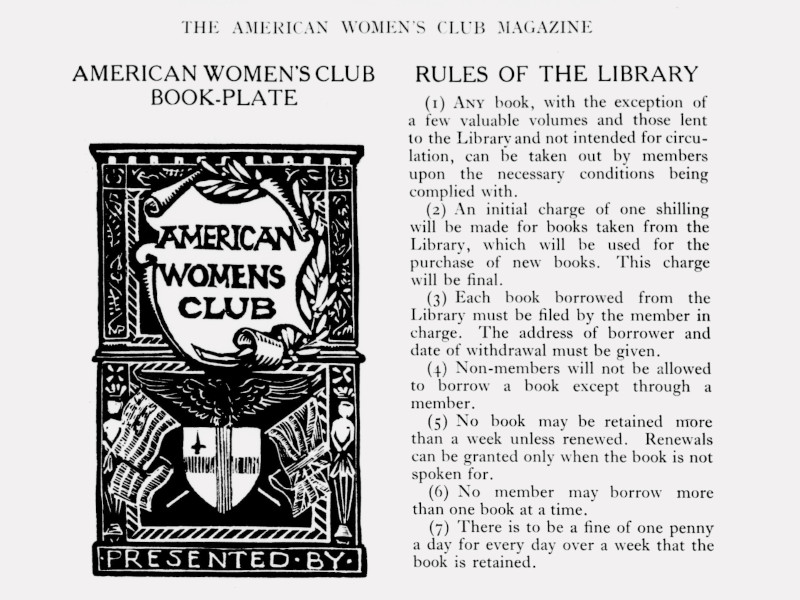
“Rules of The Library”
The AWC assembled an extensive library. This article outlines its lending rules, such as the “fine of one penny per day” for late returns. It is one of several articles in the ACWM that detail the library’s acquisitions. You can therefore track the library’s growth and, intriguingly, get a sense of what books AWC members were reading.
Licensed to access
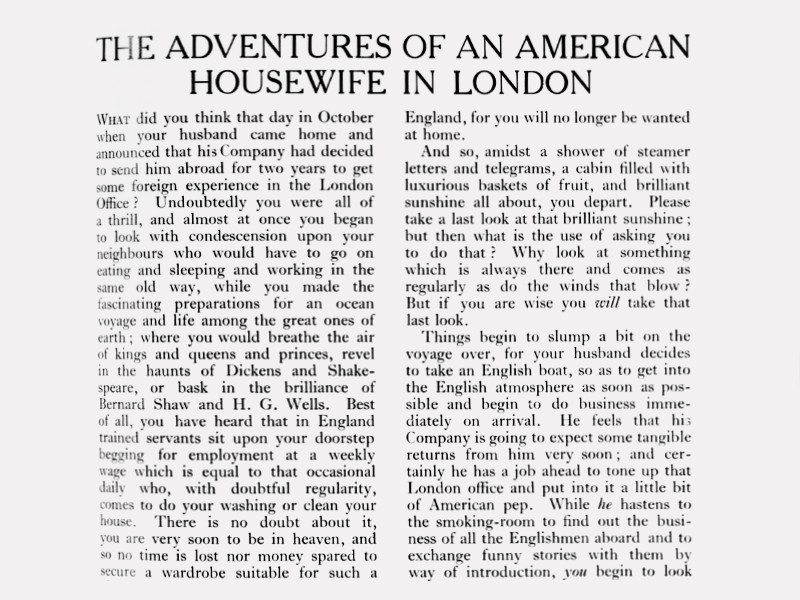
“The Adventures of An American Housewife in London”
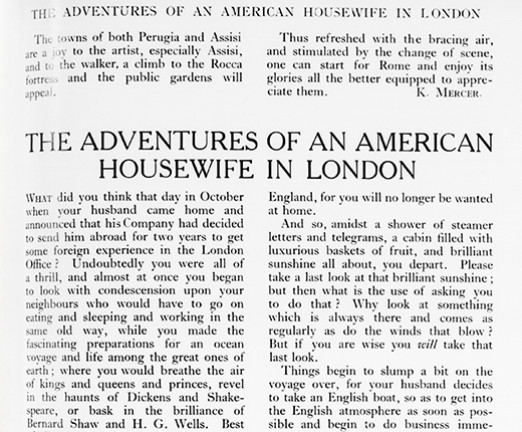
An American housewife recounts her voyage by steamer to London. Initially thrilled to escape mundane American life for "heaven", disappointment quickly sets in. She complains of dismal meals always featuring roast beef, of poor coffee resembling “black ink”, and of the “terrible hats and colossal shoes” worn by the English women onboard.
Licensed to access
“Debating Society”
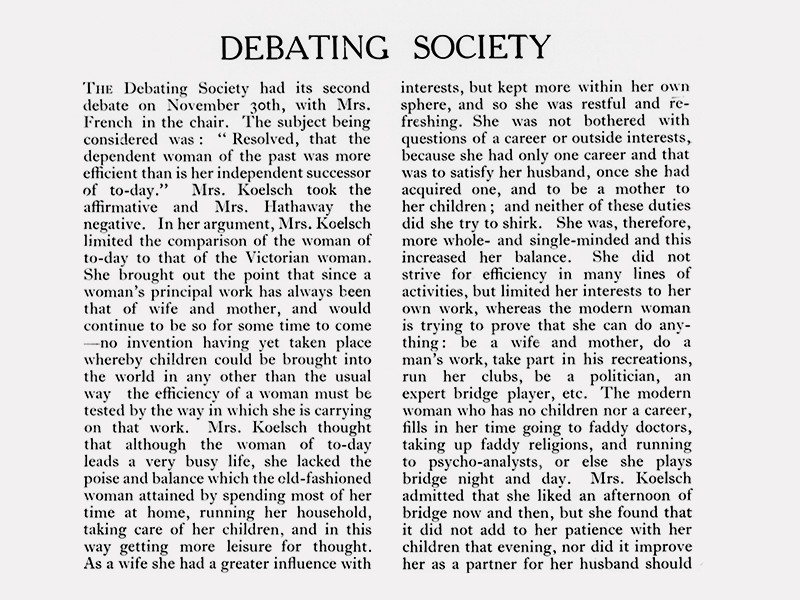
The motion for the second meeting of the AWC’s Debating Society in November 1927 was “that the dependent woman of the past was more efficient than is her independent successor”. Despite Mrs. Hathaway’s “well-though-out argument” that having “been taught how to use their minds” modern women could excel in the home and the workplace, “a large majority [voted] in favour of the old-fashioned woman”.
Insights
The AWC emerged from a conversation between 25 American women over tea in 1898. Feeling somewhat disconnected from English clubs, they envisioned one with a distinctly American ethos. The club's purpose was to foster social intercourse and connections, and to engage in educational activities and philanthropy. Their ultimate goal was to cultivate "an atmosphere of their own country in an alien land".
Initially gathering at members' homes and the Hotel Cecil, in 1911 the club settled at South Audley Street. After adopting the name AWC in 1916, it relocated to Hertford Street. By the 1920s, the club had outgrown these surroundings. The president, Mrs. Curtis Brown, secured a £25,000 loan for a mansion at 46 Grosvenor Street. This lavish headquarters boasted 30 bedrooms, an Italian garden replete with a Florentine fountain, a ballroom with a pipe organ, and a library.
The AWC valued personal development and intellectual enrichment. Its magazine details the range of activities that were organised by the club’s “Education Committee”. These included a “Debating Society” and classes on French and “Voice Production and Public Speaking”. Numerous articles in the AWCM discussed educational topics and trends. Naturally, some argued for educational systems that instilled American values within children.
The AWC exuded patriotism and aimed to cultivate a sense of home. For example, its magazine typically detailed beloved "American Recipes", such as “Southern Apple Pie”, “Cinnamon Biscuits”, “Stewed Potatoes”, “Chicken Maryland”, and “Chestnut Stuffing”. The ACWM illuminates the dietary nationalism that club members exhibited. It also gives us a sense of contemporary culinary trends in America.
The AWC was a transnational organisation, with its membership exhibiting an international outlook. Whilst the AWCM focused mostly upon the activities of the London branch, coverage extended to the USA. The “News from Other Clubs” section regularly updated members on like-minded institutions, such as the Women’s City Club of New York. The AWCM likewise featured a “Paris Notes” section and highlighted the formation of the Federation of American Women’s Clubs in Europe in May 1932. There are also references to, and articles about, the AWC branch in Shanghai.
Aspects of the AWC’s ethos were progressive, such as its commitment to women’s education. Yet it still reflected prevailing racial prejudices. A motion was “unanimously carried” at the “Quarterly Business Meeting” in June 1925: that the club’s constitution be amended to read that “only women of the white race be admitted to any kind of membership”.
Our latest “Document of the Week” was chosen by our Senior Editor, Dr Tommy Dolan. It is a short article printed in the American Women’s Club Magazine in September 1927.
Read more →
Our latest “Document of the Week”, chosen by our Editor, Nishah Malik, is lifted from an edition of the American Women’s Club Magazine, published in April 1919. The article summarises a session of the club’s lively debating society.
Read more →



.svg)